
Dairy in Sustainable Diets – Dietitian report from EFAD
My name is Carla Walker, and I am a recently qualified dietitian currently on a graduate programme with Abbott Nutrition. I previously volunteered with the Emerging INDI, a sub-committee within the Irish Nutrition and Dietetic Institute (INDI), which aims to support and represent student dietitians and recent graduates. I was honoured to receive a bursary from INDI and the National Dairy Council to attend the European Federation of the Associations of Dietitians (EFAD) Congress in Malmö, Sweden.
The theme of this year’s congress was “Rethink. Reform. Sustain”, with an aim to focus on the role of dietitians in promoting health equity and sustainable food systems. The speakers addressed current challenges in dietetic practice, including the integration of artificial intelligence (AI) in healthcare. A key message was that AI should be used to enhance, rather than replace clinical judgement.
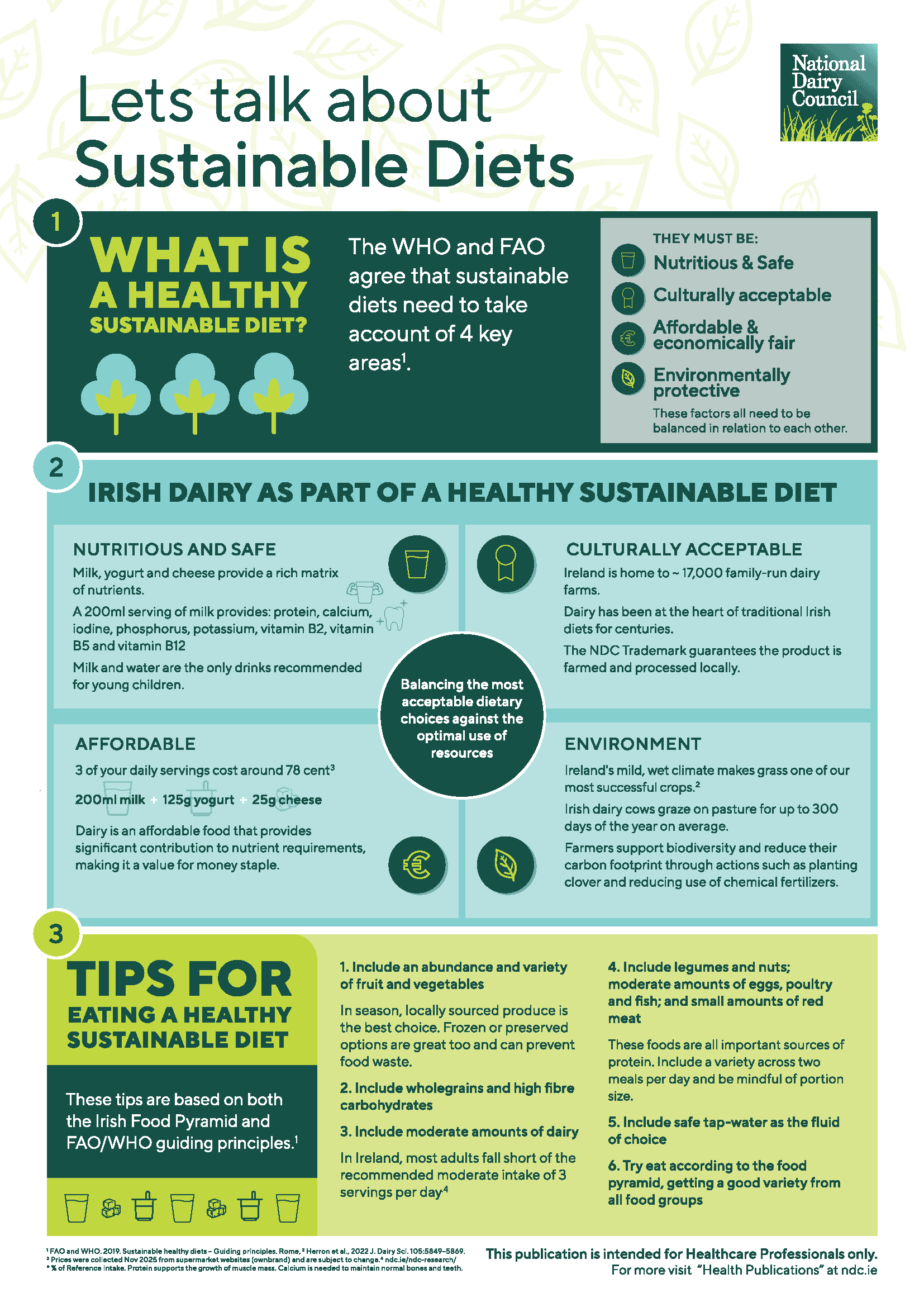
The symposium hosted by the European Milk Forum, chaired by Pauline Douglas, focused on the role of dairy in sustainable diets from nutritional, environmental, and farming perspectives.
Nutrition
Dr Anne Nugent from Queen’s University Belfast spoke about ‘Balancing the plate: nutritional adequacy in sustainable diets’. This looked at the challenges of striking the right balance between ‘nutrition’ and ‘environment’ in achieving healthy sustainable diets, and the considerable gap which exists between current eating patterns and ones which are both healthy and sustainable. Sharing insights from the MyPlanetDiet study, she emphasised iodine, noting Ireland’s reliance on milk as a primary source and the limited fortification of plant-based alternatives.
Key message: Sustainable diets should ensure adequate nutrient intake and consider the challenge for many in achieving the dietary changes needed.
Environment
Dr Anders Herlin, Swedish University of Agricultural Sciences, examined the ‘Environmental Impact and Sustainability Deliveries In Dairy Farming’. He explained that agriculture operates as an integrated system and that sustainability must be assessed across environmental, social, and economic dimensions. The impact of dairy on the environment is sometimes oversimplified focusing only on emissions, but the reality is much more complex and nuanced with positives of farming practices such as biodiversity maintenance and soil health and resilience. A challenge is to fully capture agriculture in calculations and models, noting that previous estimates of dairy’s impact often excluded full life cycle analysis and nutrient density.
Key message: Dairy farming should be viewed as a whole system, including nutrition, biodiversity, and soil health, rather than just emissions-based.
Farming Perspectives
Danish dairy farmer Hane Line Skovgaard Revsbech gave her real life experiences of ‘Cows, Community And Carbon Footprints’ describing what happens on her dairy farm, from implementing innovations and practical measures to help improve sustainability, to her and her family’s passion for farming, to the place of her farm in the local community. She applies sustainable approaches to “everything”, including climate, environment, biodiversity, resilience, economics, and work-life balance.
Key message: ‘My most important task is to leave the farm and the land to the next generation in good shape – like it was for my parents and the ones before them.’
It was an inspiring weekend as a young dietitian, looking at our role in ensuring a sustainable future for all and emerging areas for the future dietitian. Some practical takeaways we can apply moving forward include:
- AI can be a useful tool to help in both research, and in clinical practice. However, as dietitians, we must ensure that we use AI sensibly, and that it is used to aid our practice, and not replace our clinical judgement.
- Many people are far from meeting healthy and sustainable eating patterns and therefore any changes to one’s intake should be individualised, to ensure they are practical and achievable for individuals.
- When considering the sustainability of foods, it is important to consider more than just carbon footprint. Being aware of farming practices and considering a whole food systems approach can help dietitians give more balanced and informed advice to patients seeking a more sustainable diet.